New Laboratory Tests and Services
PCR Testing on CSF
PCR testing of CSF specimens is now considered standard of care for the diagnosis of meningitis and meningoencephalitis caused by Herpes Simplex Virus (HSV 1 and HSV 2). On Tuesday, October 4, 2011, the microbiology laboratory at Geisinger Medical Center will begin performing PCR testing for HSV 1 and HSV 2 from CSF specimens in-house at GMC. Previously, PCR testing for these viruses from CSF specimens was sent to a reference lab for testing.
The EPIC/Sunquest test code for Herpes Simplex Virus PCR is VIROS. This includes testing for both HSV 1 and HSV 2.
For other providers, including Proven Diagnostics clients, the test code for Herpes Simplex Virus PCR is PCRHSV. This includes testing for both HSV 1 and HSV 2.
Testing will be performed once each day, 7 days a week, for specimens received in the microbiology laboratory on or before 9:00 A.M. No stat testing will be offered for these tests. The minimum specimen volume for this testing is 1-2 ml of CSF in a sterile collection tube (do not add Universal Transport Media-UTM). Transport to the laboratory at 2-8°C.
If you have any questions about these tests, please contact microbiology laboratory director Dr. Paul Bourbeau (pbourbeau@geisinger.edu) at 570-271-7467 or microbiology technical specialist Lisa Scicchitano (lscicchitano@geisinger.edu) at 570-214-4294.
New Test for Two Polymorphisms in the Interleukin 28B Gene
Recent genome-wide association studies (GWAS) have identified IL28B genetic polymorphisms as strong determinants of response to pegylated interferon (PEG-IFN) plus ribavirin (alpha RBV) treatment in HCV genotype 1-infected individuals. Single nucleotide polymorphisms (SNPs) rs12979860 C/T and rs8099917 T/G, located upstream of the interleukin 28B gene encoding interferon lambda 3, are strongly associated with treatment-induced viral clearance. For SNP rs12979860, the favorable C allele has been associated with a 2-3 fold greater rate of sustained virological response following PEG-IFN alpha/RBV therapy and increased spontaneous viral clearance in patients infected with HCV genotype 1, while the T allele is a risk factor for non-response. The variation in rs12979860 C allele prevalence explains much of the observed racial differences in treatment response rates. In a recent US study, the more favorable CC genotype was observed in 37% of Caucasians, 29% of Hispanics, and 14% of African Americans tested. For SNPrs8099917, the favorable T allele is associated with a higher rate of sustained virologic response after therapy and increased spontaneous viral clearance in individuals infected with HCV genotype 1, while the G allele is a risk factor for non-response.
The IL28B genotype is only one of many factors that can influence response rates to PEG-IFN alpha/RBV treatment. The AASLD guidelines state “Treatment decisions should be individualized based on severity of liver disease, the potential for serious side effects, the likelihood of treatment response, the presence of comorbid conditions, and the patient’s readiness for treatment”. For genotypes other than type 1, the usefulness of these SNPs for predicting response to therapy is unknown.
Real-time polymerase chain reaction (PCR) with allele specific TaqMan probes is used to detect both single nucleotide polymorphisms. No other polymorphisms are detected by this assay. Mutations in other genes and non-genetic factors that may affect response to hepatitis C therapy are not detected. Rare diagnostic errors may occur due to primer site mutations.
Any questions should be directed to the Molecular Diagnostics Laboratory or Dr. Barbara Paynton at 1-800-695-6491.
PCR Assay for HSV and VZV from Swab Specimens
(Genital, Oral, Throat, NP, Conjunctival, Skin, Perineum)
On Tuesday, March 1, 2011, the Geisinger Microbiology laboratory introduced a realtime PCR assay for the detection of Herpes Simplex Virus types 1 and 2 (HSV 1 and HSV 2), and Varicella Zoster Virus (VZV) from swab specimens. These PCR assays will replace viral culture and direct fluorescent antibody (DFA) testing for HSV and VZV from swab specimens only.
This change has been made following an extensive validation of a new PCR assay. During our validation, we were able to show increased sensitivity for the PCR assay compared to DFA/culture methods, particularly for VZV. Moreover, the turn around time for the assay will be substantially shortened.
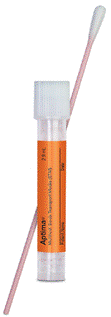
For GHS patients, testing from these sources will continue to follow the GHS standard of care protocols that are currently employed. Genital and oral specimens will be tested for HSV 1 and HSV 2 (VZV testing will only be performed when specifically requested) while dermatological specimens will always be tested for HSV 1, HSV 2, and VZV. Testing for HSV and/or VZV from all other swab specimen sources (e.g. conjunctival) will be performed as requested by clinicians. We will continue to use the same collection swabs (flocked swabs) that are supplied with the viral transport media, Universal Transport Media (UTM), for collection of specimens for HSV and VZV detection from swab specimens. GHS providers will continue to order this test by selecting VIRAL STUDIES, test code – VIROS.
Outreach and non-GHS providers will order test codes PCRHSV for HSV 1/ HSV 2 and/or PCRVZV for VZV testing. We will continue to use the same collection swabs (flocked swabs) that are supplied with the viral transport media, Universal Transport Media (UTM), for collection of specimens for HSV and VZV detection from swab specimens.
Testing will be performed once daily Monday-Saturday. Specimens received in the microbiology laboratory before 10:00 A.M. will be tested and reported that day. No STAT testing will be offered.
Importantly, we will not be performing PCR testing for HSV or VZV from other specimen types such as CSF, tissue, or respiratory wash specimens at this time. We anticipate adding PCR testing for other specimen types for HSV and VZV in the future after additional validation studies have been completed. The introduction of this testing is part of a comprehensive plan to replace all of the traditional viral tissue culture/DFA testing with PCR based technologies. Last year, we introduced the RVP PCR for the detection of respiratory viruses. The introduction of PCR testing for HSV and VZV from swab specimens is another step in the transition process.
For further information, please contact Dr. Paul Bourbeau, Director of Microbiology, or Lisa Scicchitano, Technical Specialist, at 1-800-695-6491.